
Escaping the Pit: How I support perpetrators to stop them harming others
Author: Warren Betts, Domestic Abuse Perpetrator Case Officer at Halton Borough Council.
The views expressed in this blog are those of the author and do not necessarily reflect the views of the Centre for Safer Society.
“Why?” “Why would you want to do that?”
These questions are some of the more popular responses when I explain what I do, and that is from people who work in the social care realm. People who don’t just look uncomfortable and quickly change the subject. The concept that people who perpetrate domestic violence, abuse and control should not be supported and challenged to change, or cannot change still holds firm.
This is despite everything we know: that post-separation abuse carries on for years; that perpetrators will move on to new relationships and start abusing again. Most of all, we know that it won’t stop on its own.
Wanting to change
It sounds obvious, but I cannot support someone who harms to change their harmful behaviours unless they want to. They have to invest in the process. At the beginning, they may only have external motivation to attend, such as being court-ordered, or being advised by social care. As we progress, I help them to explore and develop internal motivations.
I work from the foundation of the humanist philosophy, which means that I believe within each and every person is a desire to live a good and ethical life.
I believe that their harmful behaviours are a choice: they choose to use violence and abuse because it serves a purpose to them, and they benefit from it in some way, which is why they choose to do it.
So much of my role involves helping people who harm others to become conscious of this, and challenging them to acknowledge the reasons for choosing to behave as they do.
The Pit
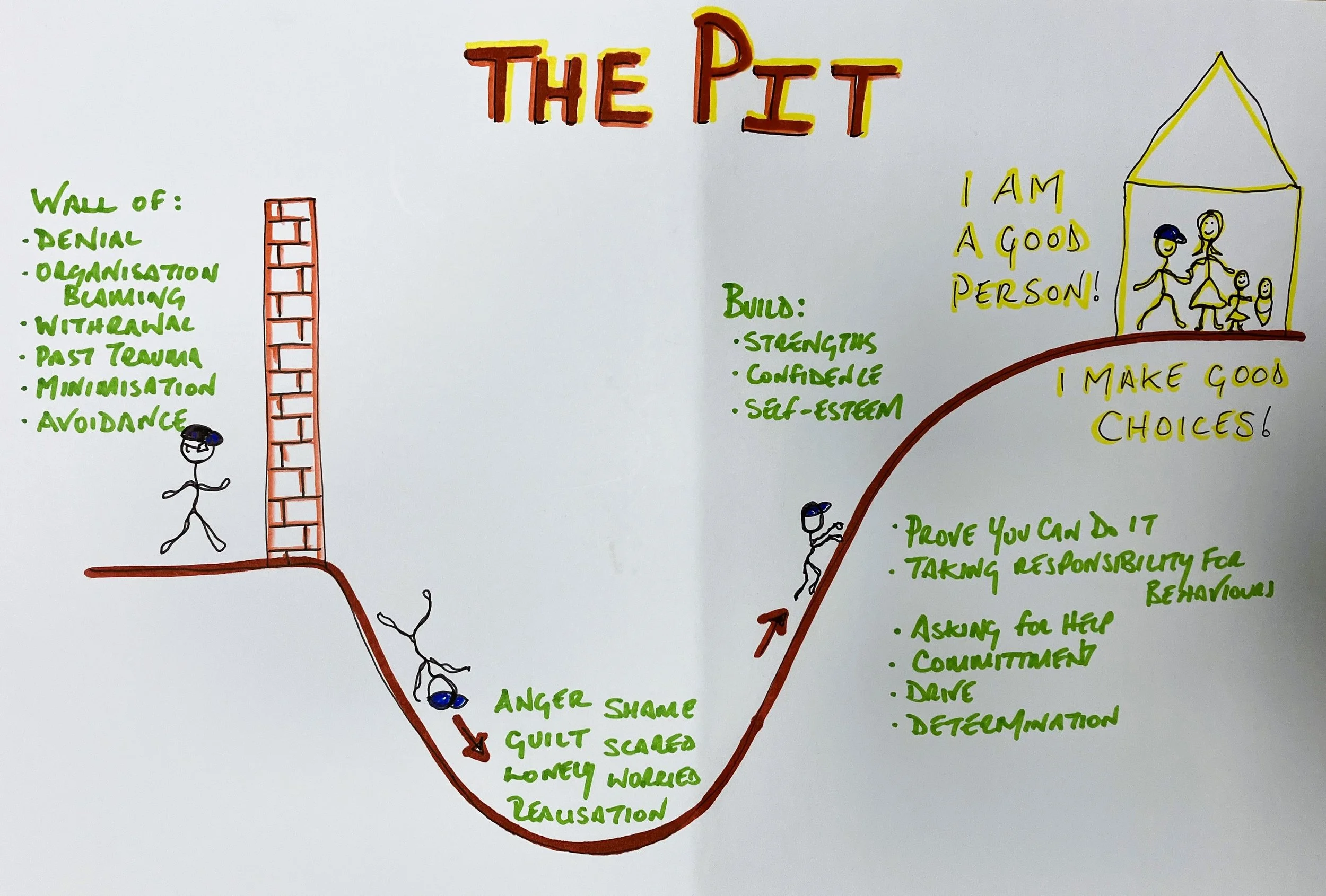
The pit is one of the key visuals I use to explain the process of the intervention. The majority of people I work with will at first be behind the wall. The wall is made up from their minimisation of their abusive behaviours, their victim blaming, their denial.
Behind their wall they are safe; they don’t have to face up to the harm they’ve caused or are still causing, or to change their behaviour.
So my first job is to dismantle that wall, either brick by brick or with a wrecking ball.
Once the wall has gone, then they fall into the pit. This is when they come to the realisation that their choices, their behaviours, have been harming others. This brings with it a whole gamut of emotions including, depression, guilt and shame.
If we were to leave them there, they would climb back up and rebuild their wall higher and stronger to hide behind. That’s because being behind the wall is where they feel safe, and don’t have to confront the impact of their behavioural choices.
CHOICES programme
So instead, the CHOICES behavioural change programme allows people who harm to reflect on their behaviour and its consequences in the light of their own values and goals. Together, we move them away from the wall and towards their behavioural change goals. This realisation that they can make good choices leads them up out of the pit.
One client said: “The first 4 or 5 sessions/weeks were hard because of what I was having to tell you. Not just about jail, but talking about my life.
Talking about feelings, bringing them to the surface, it was very hard. It was unsettling and upsetting. It sends you into a deeper way of thinking about things. I know that you have to, to move forward, but it is not nice! I felt like I didn’t have it in me.
We talked about depression…and the steps, and I could see that and it made sense! Going out of them (the sessions) thinking about what we been through, thinking about stuff we’ve gone through during the week, it was really hard!
But then it starts to feel more positive. I felt like I could say how I were feeling, I felt like I was coming out of The Pit! I was coming out feeling better!
Through guided discovery, the CHOICES behavioural change programme explores many topics including: the impact of domestic abuse on partners and children; healthy relationships; accountability; self-esteem and resilience; risk assessment and safety planning; triggers; positive parenting; and mental health. The programme is delivered over 24-32 sessions on a 1:1 basis.
It consists of overlapping components through which we explore our thoughts, values and beliefs, our actions and their consequences and skill developments. We also explore the impact their actions have on external environment and vice versa. What we want them to achieve is a framework of meaning for their lives so they can understand their own behaviour. We want to help them to resolve past traumas whilst gaining cognitive skills and everyday skills, to think and learn about emotional regulation and to learn self-restraint whilst building their strengths and their resilience and modelling how to get on with others and developing social skills.
In the words of another client:“When I first joined, I wasn’t fully aware of how my actions and behaviour affected others. I thought change was only about meeting external expectations, but through the sessions, I began to understand the wider impact of my choices — not just on those closest to me, but on colleagues, friends, and the community around me. This course gave me the opportunity to stop, reflect, and take responsibility. It challenged me to look honestly at myself and the harm my behaviour had caused. That was not easy, but it was necessary”.
Warren Betts
Warren is the Domestic Abuse Perpetrator Case Officer at Halton Borough Council, and he created the CHOICES behavioural change programme for people who harm. He is a White Ribbon Ambassador, Coordinated Community Response Leader, an accredited Good Way Model Therapist & Good Way Mentor, Solution-focused Brief Therapist, CBT trained, Lifeline Practitioner and a Level 4 Trainer.