
Just go? Why risk assessment must change before we ask survivors to leave
Author: Saskia Lightburn-Ritchie, CEO of MyCWA.
The views expressed in this blog are those of the author and do not necessarily reflect the views of the Centre for Safer Society.
“Why don’t you just leave?”
It’s the question survivors hear most often. And it’s the wrong question. After 30 years working in the domestic abuse sector, I've learned that leaving is often the most dangerous thing a survivor can do, especially when we haven't put proper protection in place first.
I’m currently analysing interim data from Our Own Words 2026, a survivor-led survey aiming to become the UK's largest of its kind (you can add your views via the button at the end of this blog). We have now heard from 423 survivors across all four UK countries. What they are telling us is stark. Services are failing to assess risk properly, and that failure is putting lives in danger.
Leaving can be the most dangerous time
The evidence of this is clear. The Femicide Census found that, where women had separated (or tried to), 89% were killed within the first year, and 38% were killed within the first month. Read that again. First month. Not years later. Not "when things calm down".
Globally, it’s the same pattern. UNODC and UN Women report on femicide tells us that in 2023 around 51,000 women and girls were killed by intimate partners or family members, and that home remains the most dangerous place for women.
So, when we tell someone to "just leave" without assessing what happens next, we are not keeping them safe. We may be putting them in greater danger.
What survivors are telling us
Our Own Words 2026 is proudly survivor-led. Every question was designed by survivors. We are not collecting data about others. We are creating evidence together.
And what is coming in is consistent and damning.
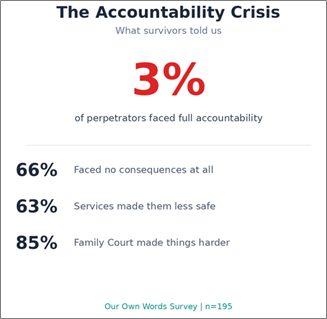
59% of respondents say a service made them feel less safe or caused further trauma. Another 26% are not sure. Only 3% say perpetrators were held fully accountable.
And when survivors use systems that are meant to protect children and manage safety, they often describe harm, minimisation, and disbelief. If you want one headline that should shame us into action, it’s this:
Abuse does not end when you leave.
In this most recent dataset, 73% of people who have separated say they experienced post-separation abuse. Not a rare exception. A common pattern.
One survivor put it simply: "DV does not stop when you leave. They use the kids and court to destroy you"
Another told us: "My ex strangled me and I could have died. I knew there would be nothing to stop him. A piece of paper is useless if someone is not locked away."
That reference to strangulation matters. Non-fatal strangulation is strongly linked to future homicide risk, and it must be treated as a serious warning sign, not a footnote.
Where risk assessment is failing
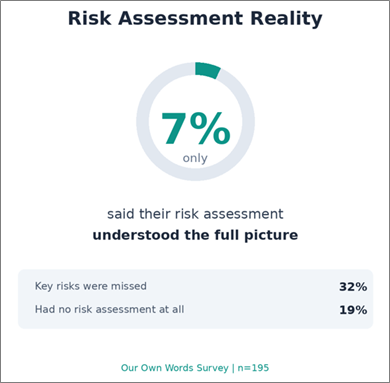
Here is what I think is going wrong. Too many risk assessment processes focus narrowly on physical violence. The bruises. The broken bones. The incidents that can be photographed. They miss the patterns of coercive control. They miss escalation points. They miss how perpetrators weaponise children, systems, and court processes to keep control after separation.
One survivor explained: "Social services queried whether it was parental conflict the first time and also years later, even though a restraining order was in place. CAFCASS also initially did not do a proper risk assessment."
Another shared this jaw-dropping response from social care: "I reported an incident of stalking and was told I should give him credit for not getting out of the car and doing anything."
When threats like "If you leave, Ill ruin you" or "Youll never see the kids again" are treated as drama rather than danger, we are failing survivors.
What would actually help
Survivors are clear about what they need. Better understanding from professionals is the top priority for change (79%). Holding perpetrators accountable comes next (73%). And of those who have had support, 84% say being believed and not judged was the most helpful thing any service did.
That should not be hard.
Effective risk assessment looks at patterns and escalation, not isolated incidents. It asks about non-fatal strangulation, stalking, threats to kill, weapons access, separation, coercive control, child contact conflict, and suicide threats used as control. (SafeLives, n.d.; Backhouse and Toivonen, 2018; Mandel, 2024)
One survivor wrote: "By the time someone seeks help, they are almost totally broken and need someone to give them hope and options. The survivor knows the abuser better than anyone, so believe them fully when they tell you their fears. Their fear is real and developed from experience, not an overactive imagination."
A systems problem needs a systems response
This isn't about one failing professional or one poorly designed form. It's a systems problem. We need change across all three dimensions: the people doing the work, the structures they work within, and the evidence informing their decisions.
For the people: those supporting survivors need training that goes beyond recognising bruises. Professionals must learn to understand coercive control, post-separation abuse, and how perpetrators manipulate systems.
For the structures: services need risk assessment tools that capture the full picture, policies that don't pressure contact arrangements without safety planning, and accountability when things go wrong.
For the evidence: we need to start listening to survivors. Not as an afterthought, but as the starting point. Our Own Words 2026 is showing that survivors have been telling us what's wrong for years. We just haven't been listening.
Before we say: “Just leave”
We can do better. We must do better.
Before we ask someone to leave, we need to ask ourselves: What protection are we actually offering? If the answer is "a piece of paper and a crossed fingers approach", we are not keeping anyone safe.
Our Own Words 2026 closes on the 31st March, although the get involved link will remain open permanently. We will publish its full findings in April 2026. The report will be written by survivors, not just about them. We are aiming for 1,000 responses so these findings cannot be dismissed.
If you want to get involved, let us know by filling out this short contact form.
If you would like to share or participate in the full survey, it takes about 30 minutes. Every one of those minutes counts. Your voice matters.
Quiet voices are louder together.
Saskia Lightburn-Ritchie
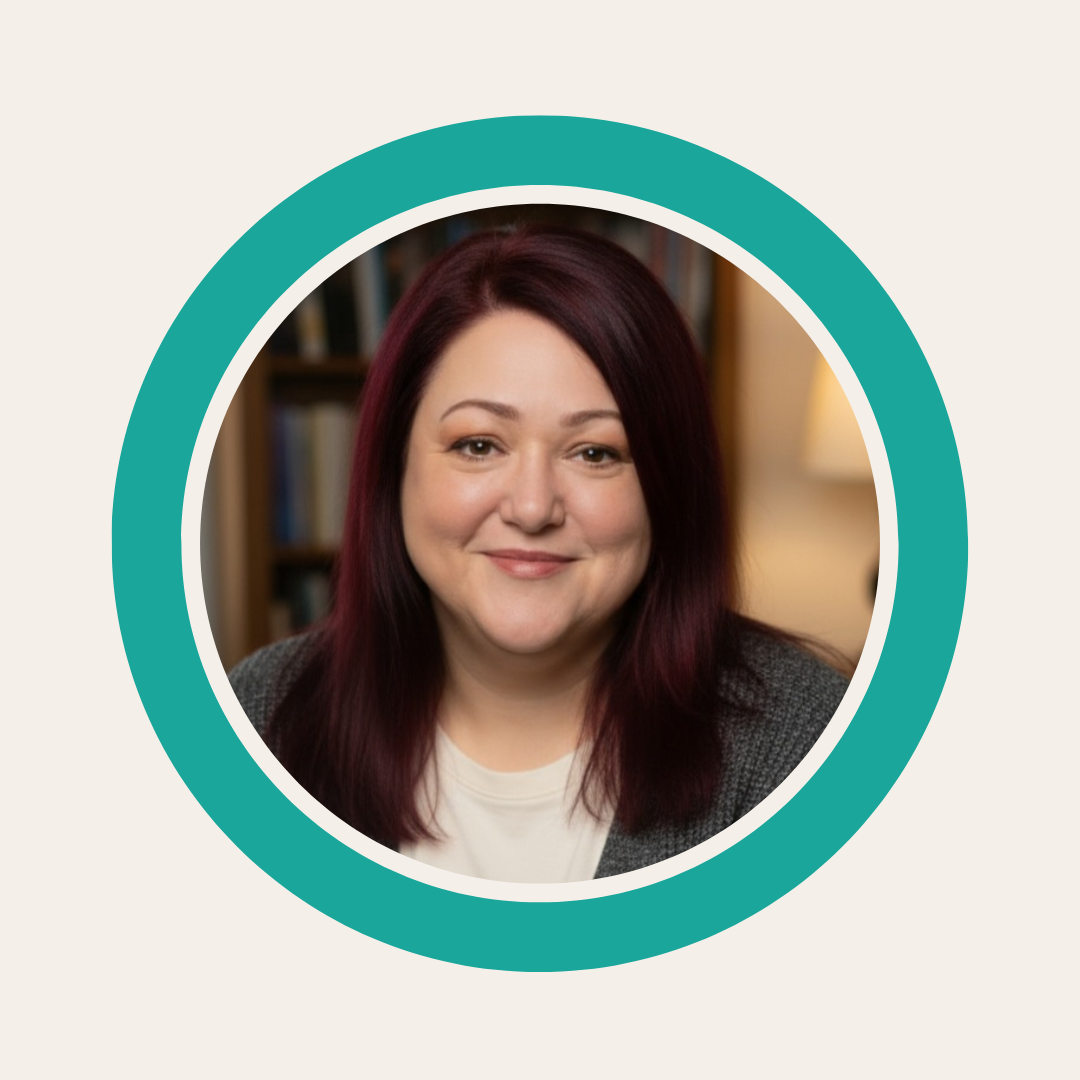
Saskia is CEO of MyCWA and Founder of Domestic Abuse Experts, a survivor with over 30 years' experience in the domestic abuse sector. She is the author of Reframing Risk in Domestic Abuse: A Practitioner Handbook and is leading Our Own Words 2026, with Samantha Billingham from Stronger Beginnings, the goal of which is to develop the UK's largest survivor-led survey of domestic abuse experiences.
SafeLives (n.d.) Dash risk checklist and FAQs. Available at: https://safelives.org.uk/resources-library/dash-risk-checklist/ (Accessed: 20 February 2026).
SafeLives (n.d.) SafeLives Dash risk identification checklist for use by IDVAs and other non-police agencies (PDF). Available at: https://safelives.org.uk/wp-content/uploads/Dash-risk-checklist-for-Idvas.pdf (Accessed: 20 February 2026).
Backhouse, C. and Toivonen, C. (2018) National Risk Assessment Principles for domestic and family violence: Companion resource. Sydney: ANROWS. Available at: https://anrows-2019.s3.ap-southeast-2.amazonaws.com/wp-content/uploads/2018/07/19030418/ANROWS_NRAP_Companion-Resource.1.pdf (Accessed: 20 February 2026).
Mandel, D. (2024) ‘Beyond co-occurrence: The interplay of coercive control, suicide and homicide’. Safe and Together Institute, 4 November. Available at: https://safeandtogetherinstitute.com/blog/beyond-co-occurrence-the-interplay-of-coercive-control-suicide-and-homicide (Accessed: 20 February 2026).